
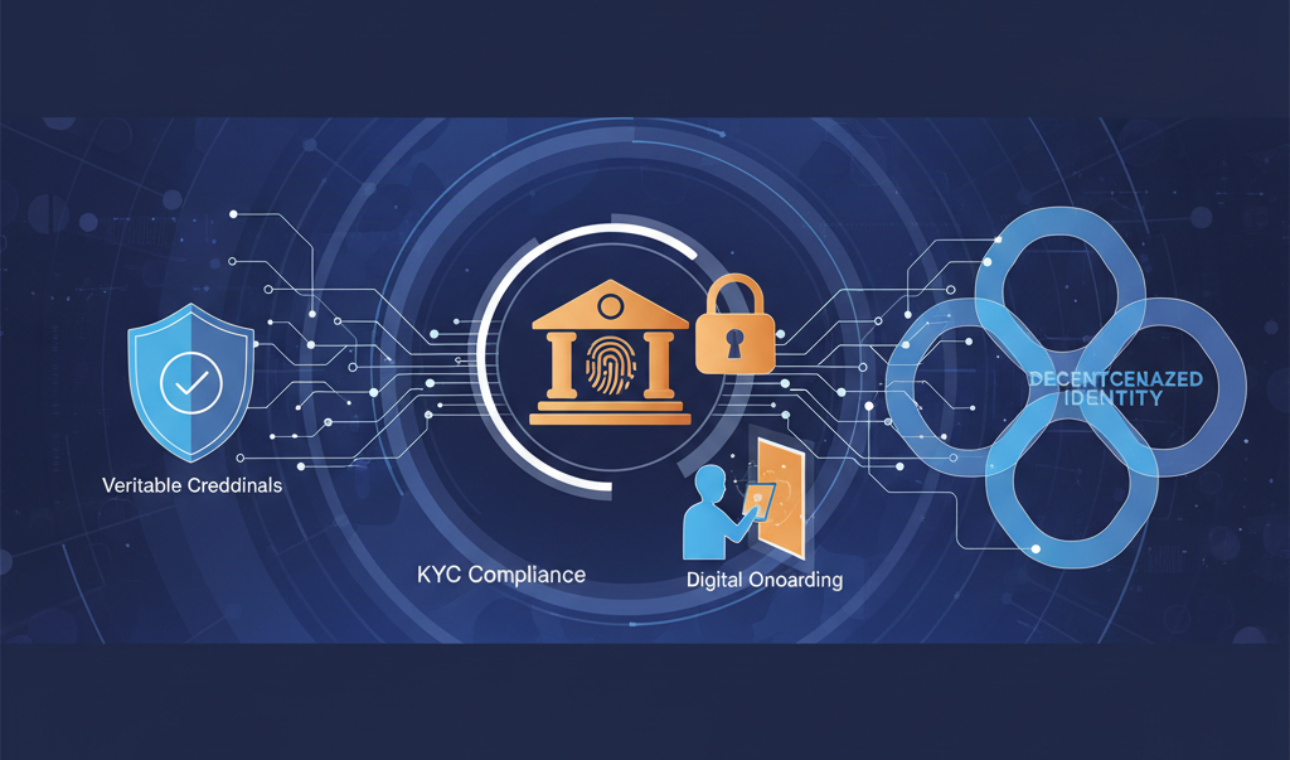
The digital transformation of banking has solved many customer-facing friction points, yet customer onboarding and identity verification remain stubborn pain points. For global financial institutions, Know Your Customer (KYC) and Anti-Money Laundering (AML) compliance represent a delicate balancing act. On one hand, institutions must satisfy increasingly stringent regulatory mandates to prevent financial crime. On the other, they must minimize sign-up friction, as tedious verification processes routinely lead to customer abandonment rates exceeding 60% in retail banking.
Historically, banks have relied on centralized, siloed databases to manage customer identity. This legacy approach requires customers to repeatedly submit passports, utility bills, and tax documents every time they open a new account or access a different financial product. Beyond the repetitive friction, these massive repositories of Personally Identifiable Information (PII) serve as high-value targets for cybercriminals. Under this paradigm, the operational costs of identity verification continue to scale unsustainably.
A paradigm shift is underway. Decentralized Identity (DID), underpinned by W3C-standardized Verifiable Credentials (VCs), offers a path forward. By shifting identity control from centralized servers to the user, financial institutions can transition from costly, repetitive verification processes to instant, cryptographically verifiable onboarding. This article explores how decentralized identity is reshaping the KYC compliance landscape, the underlying technology drivers, the evolving regulatory environment, and the strategic steps banks must take to adapt.
—
Why Decentralized Identity Matters: The Structural Flaws of Legacy KYC
The current compliance model for financial institutions is built on redundant verification. Every bank, fintech firm, brokerage, and insurer performs its own separate KYC check from scratch. This system is inefficient for three primary reasons: escalating costs, customer abandonment, and systemic security risks.
According to research by LexisNexis Risk Solutions, the global cost of financial crime compliance reached $206.1 billion in 2023. A significant portion of this capital is spent on manual document review, data verification, and third-party database lookup fees during identity verification processes.
This operational burden is compounded by friction-induced revenue loss. In a digital economy where consumers expect instant gratification, requiring users to upload identity documents, wait for manual verification, or visit a physical branch leads to high drop-off rates. For corporate and commercial banking, where customer due diligence (CDD) and Know Your Business (KYB) requirements are far more complex, onboarding can take anywhere from 20 to 90 days. During this window, prospective business clients often abandon the process entirely in favor of more agile competitors.
Additionally, legacy KYC systems create massive security vulnerabilities. Banks store scans of driver’s licenses, tax certificates, and passport documents in central data warehouses. This concentration of PII attracts sophisticated cyberattacks. A data breach at a single repository can compromise millions of identities, exposing banks to severe regulatory fines under frameworks such as GDPR and CCPA, as well as catastrophic reputational damage.
Decentralized identity addresses these vulnerabilities by decomposing the central database. Instead of storing sensitive raw data, banks can verify identity by confirming cryptographically signed attestations, neutralizing the centralized honeypot risk and drastically lowering the cost of customer acquisition.
—
Key Technology and Market Drivers: Verifiable Credentials and the Trust Triangle
The shift to decentralized identity is driven by a maturing suite of open-source standards championed by the World Wide Web Consortium (W3C) and the Decentralized Identity Foundation (DIF). To understand how decentralized identity operates in a banking environment, we must examine the Trust Triangle, which consists of three core components: the Issuer, the Holder, and the Verifier.
- The Issuer: An authorized entity (e.g., a government agency, utility company, or a bank) that verifies an individual’s identity attributes and issues a digitally signed Verifiable Credential (VC) to them.
- The Holder: The individual or corporate entity who receives and stores these credentials in a secure digital wallet on their personal device (like a smartphone). The Holder has complete control over who accesses this data.
- The Verifier: An organization (such as a second bank or a fintech company) that needs to confirm the Holder’s identity. Instead of demanding raw documents, the Verifier requests the VC and uses public keys anchored on a shared directory (such as a decentralized ledger or a secure public registry) to instantly verify the digital signature’s authenticity.
The Technical Landscape of Privacy: Zero-Knowledge Proofs
One of the most powerful technology drivers of decentralized identity is the integration of Zero-Knowledge Proofs (ZKPs). ZKPs allow a holder to mathematically prove that a statement is true without revealing the underlying data. For instance, a customer can prove they are over the age of 21, or that their monthly income exceeds a specific threshold, without sharing their exact birth date or revealing their salary figures. This capability allows banks to satisfy regulatory requirements while minimizing data minimization risks under modern privacy laws.
Hypothetical Scenario 1: Retail Account Opening
Consider a retail customer, Sarah. Under the legacy model, when Sarah opens an account at Bank A, she must scan her passport and upload a utility bill. A week later, Sarah wants to open an investment account with Robo-Advisor B.
Under a decentralized identity framework, Bank A verifies Sarah’s identity once. Upon verification, Bank A issues a cryptographically signed Verifiable Credential certifying that “Sarah is KYC-verified up to AML Level 2.” This credential is saved to Sarah’s secure digital wallet. When Sarah registers with Robo-Advisor B, she shares this credential directly from her wallet in seconds. Robo-Advisor B instantly validates the signature of Bank A against a registry of trusted issuers, onboarding Sarah immediately without seeing or storing her raw passport scan.
Hypothetical Scenario 2: Frictionless B2B Corporate Onboarding
In corporate banking, KYB processes are notoriously complex, requiring proof of incorporation, beneficial ownership structures, and director identities. Consider Global Logistics Corp, which wants to open accounts with three regional banks to optimize its international logistics network.
Instead of submitting physical articles of incorporation and notarized director certificates to three different institutions, Global Logistics Corp obtains a Verifiable Corporate Credential from its home country’s registry of companies. When onboarding with any partner bank, the company presents this cryptographically verifiable presentation. The regional banks verify the business identity in real-time, reducing onboarding times from weeks to minutes and accelerating time-to-revenue for both the corporate client and the banks.
—
Regulatory, Security, and Risk Considerations
While the business case for decentralized identity is clear, compliance officers and risk management heads must evaluate how this shift aligns with global regulatory standards. Regulators are gradually embracing decentralized frameworks, recognizing their potential to reduce identity fraud and enhance data privacy.
eIDAS 2.0 and the European Digital Identity Framework
The most significant regulatory driver of decentralized identity is the European Union’s eIDAS 2.0 regulation, which mandates that all EU Member States provide a European Digital Identity (EUDI) Wallet to citizens and businesses by 2026. Crucially, the regulations require large private sectors, including financial services and banks, to accept these wallets for user authentication and onboarding. This regulatory mandate transforms decentralized identity from a futuristic experiment into an immediate operational requirement for any institution doing business in Europe.
The Financial Action Task Force (FATF) Position
The Financial Action Task Force (FATF), the global watchdog for money laundering and terrorist financing, has updated its guidance on digital identity. FATF explicitly supports the use of robust digital ID systems, noting that secure digital identity solutions can improve the reliability of CDD checks while reducing the human error associated with manual verification processes. FATF emphasizes that financial institutions must understand the reliability and independence of the underlying digital ID technology stack, highlighting the importance of standardized protocols.
Addressing Security, Custody, and Interoperability Risks
Transitioning to decentralized identity introduces new risk vectors that risk heads must mitigate:
- Credential Theft & Device Security: Because credentials reside inside a hardware-backed enclave on consumer smartphones, the target of identity theft shifts from the bank’s servers to the consumer’s device. Financial institutions must design robust recovery procedures if a user loses their phone or cryptographic keys.
- Interoperability Standards: For decentralized identity networks to succeed, credentials issued by one entity must be readable by another. Financial consortia must align on standardized taxonomy models, such as those defined by the World Wide Web Consortium (W3C), to ensure international interoperability.
- The Liability Question: If Bank A issues a KYC credential to a customer, and Bank B accepts that credential for onboarding, who bears responsiblity if the customer later engages in money laundering or turns out to be using a synthetic identity? Clear legal frameworks and mutual-indemnification templates between network participants are essential to manage this systemic risk.
—
Strategic Integration: A Practical Implementation Roadmap for Financial Institutions
For most banks, transitioning to decentralized identity is not an all-or-nothing proposition. Rather, successful integration involves a multi-phased approach that legacy cores can gradually absorb without disrupting current operations.
Phase 1: Readiness Assessment and Use Case Definition
Begin by mapping all current identity-related workflows. Identify where friction is highest within your customer journey—whether it is in retail onboarding, credit application flows, or wealth management sign-ups. Evaluate your current core system infrastructure to determine if it can leverage REST APIs and modern cryptographic libraries required to interact with decentralized identity tools.
Phase 2: Establish a Hybrid Architecture
Financial institutions do not need to abandon their existing identity databases overnight. Instead, adopt a hybrid model. Banks can build or integrate middleware that serves as an “Identity Bridge.” This bridge can accept traditional document uploads and, at the same time, integrate standard decentralized wallet protocols to ingest Verifiable Credentials from customers who already possess them.
Phase 3: Ecosystem Collaboration and Standardization
Decentralized identity gains value through network effects. Financial institutions must collaborate with external stakeholders—competitors, government bodies, and telecommunications companies—to build trusted ecosystems. Participating in sandbox testing environments and industry groups allows institutions to influence emerging data standards and cross-border verification rules.
Staying informed of these rapidly moving compliance trends requires direct dialogue with key innovators. The Future Fintech Awards & Conference series, organized by Global Next Media Corp., serves as a global platform for leaders in fintech and financial services to meet, share insights, and celebrate innovation. To connect with C-level peers and explore implementation strategies for decentralized systems, you can register your interest, apply for awards, propose a session, or enquire about sponsorship for the upcoming 2027 regional summits:
- Toronto — 19 April 2027
- Paris — 11–12 May 2027
- Singapore — 14–15 September 2027
Participating in these forums helps product and risk leaders benchmark their decentralized identity roadmaps against global best practices and regulatory shifts.
—
Actionable Takeaways for Financial Leaders
To successfully navigate the transition toward decentralized identity, fintech founders, C-suite executives, and risk/compliance heads should prioritize the following actions:
- Appoint an Identity Architect: Establish a cross-functional task force consisting of product managers, identity engineers, and senior compliance officers to explore decentralized standards, specifically W3C Verifiable Credentials and Decentralized Identifiers (DIDs).
- Audit Existing Onboarding Pipelines: Analyze drop-off rates, average customer acquisition costs (CAC), and manual compliance processing times. Use this data to calculate the potential ROI of deploying an instant, credential-based onboarding system.
- Build a Pilot Proof-of-Concept (PoC): Launch a small-scale, high-impact pilot. For example, issue a digital credential to bank staff or select retail cohorts that allows them to instantly authenticate their identity when switching between different mobile banking apps or web portals.
- Monitor eIDAS 2.0 Compliancy: Ensure your product engineering roadmaps accommodate the technical frameworks outlined by the European Commission, as these specifications will likely influence digital wallet standards globally.
- Join Industry Consortia: Participate actively in developer-driven groups like the Decentralized Identity Foundation (DIF) or regional banking associations. Defining data standards early protects your organization from proprietary technology obsolescence.
—
Conclusion
The traditional banking onboarding experience is built on a structure of friction, redundancy, and risk. Decentralized identity transforms this dynamic, shifting the core paradigm from database validation to cryptographically proven credentials. By allowing consumers and businesses to hold verified attestations in secure digital wallets, banks can achieve the dual goal of driving onboarding drop-off rates down to near-zero while simultaneously lowering their compliance operating costs.
As regulatory frameworks like eIDAS 2.0 begin to turn decentralized identity from an elective optimization into a legislative mandate, proactive institutions are positioning themselves to leverage this technology as a core competitive advantage. The future of banking identity is secure, privacy-preserving, and customer-centric.
Where to Learn More
To explore the evolving technical standards behind decentralized digital identification, consult the following industry organizations and specifications: