
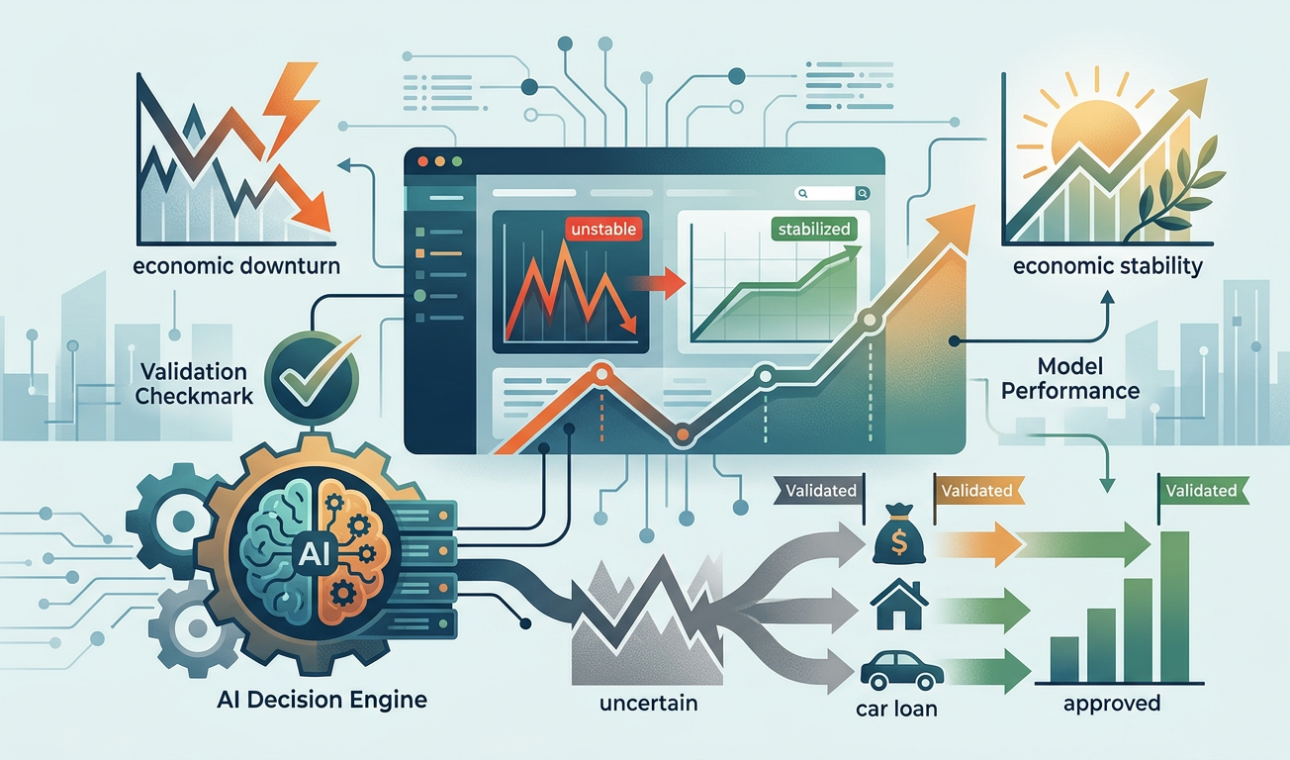
The transition from manual underwriting to automated, artificial intelligence (AI) and machine learning (ML) decisioning has transformed the economics of retail and commercial lending. Automated pipelines process applications in seconds, utilizing alternative data streams, real-time transaction mapping, and non-linear classification models to price risk at scale. Yet, the predictive power of these models is not static. They are designed to identify patterns in historical data, making them highly vulnerable to changing real-world conditions.
When macroeconomic conditions shift rapidly—marked by fluctuating interest rates, inflationary shocks, and changing labor market dynamics—the assumptions embedded within training datasets can degrade. This phenomenon, known as model drift, presents a material risk to financial institutions. Unchecked model drift leads to mispriced risk, inflated default rates, or, conversely, over-conservative lending decisions that choke off viable loan-origination revenue. For risk officers, product leaders, and compliance executives, establishing a robust validation framework to detect and mitigate model drift during volatile economic cycles is no longer a theoretical exercise; it is an operational and regulatory necessity.
—
Understanding Model Drift: Concept vs. Covariate Shift
To design an effective validation and mitigation strategy, risk professionals must distinguish between the two primary categories of model drift: covariate shift (data drift) and concept drift.
Covariate Shift (Data Drift): Occurs when the statistical distribution of the model’s input variables changes over time, while the underlying relationship between those inputs and the target variable (default risk) remains the same.
A typical example of covariate shift occurs when a sudden economic downturn leads to a widespread decline in applicant credit scores or average household savings. Even if a credit score of 620 carries the same probability of default (PD) as it did previously, the average applicant profile entering the funnel has shifted, requiring the model to process a disproportionate volume of marginal applications.
Concept Drift: Occurs when the statistical properties of the target variable itself change, meaning the historical relationship between the input features and the actual outcome breaks down.
In highly volatile cycles, concept drift presents a more severe threat. For example, during a period of rapid inflation coupled with flat wages, an applicant with a debt-to-income (DTI) ratio of 35% may exhibit a significantly higher risk of default than an applicant with the same 35% DTI did two years prior. The underlying meaning of the metric has changed because non-discretionary costs (such as food, energy, and rent) consume a larger share of the borrower’s cash flow, rendering the model’s historical risk associations invalid.
The financial impact of failing to detect these shifts is severe. If an automated decisioning engine operates on outdated correlations, it will continue to approve borrowers whose actual risk profile has deteriorated, leading to credit losses, capital adequacy erosion, and potential regulatory intervention.
—
Technology and Market Drivers: Why Static Validation Fails
Historically, model risk management (MRM) operated on a periodic, static schedule. Traditional, linear scoring models (such as FICO-based scorecard regressions) were validated quarterly or annually. This cadence was sufficient because the underlying features changed slowly, and credit cycles progressed over years, not weeks.
Several market and technological drivers have rendered passive validation obsolete:
- High-Velocity Alternative Data: Modern automated lenders feed alternative data—such as open banking cash-flow histories, utility payment records, and e-commerce transactions—directly into their underwriting models. While these features provide real-time insight, they are highly sensitive to sudden macroeconomic shocks and consumer behavior changes.
- Non-Linear Model Architectures: Machine learning architectures, such as gradient boosted decision trees (GBDTs) and deep neural networks, excel at identifying complex, non-linear interactions between variables. However, these models are less transparent than traditional logistic regressions. When drift occurs, the specific point of failure can be difficult to diagnose without advanced explainability frameworks.
- Unprecedented Macroeconomic Volatility: The classic decade-long business cycle has been replaced by compressed, highly volatile economic episodes. Rapid monetary tightening, sudden fiscal stimulus interventions, and localized labor market disruptions mean that historical training data from even three years ago may fail to reflect current realities.
When underwriting models operate in these high-velocity environments, static validation schedules create an dangerous blind spot. By the time an annual audit identifies that a model’s Gini coefficient or Area Under the Receiver Operating Characteristic (AUROC) curve has degraded, the institution may have already accumulated millions in bad debt.
—
Regulatory, Compliance, and Risk Considerations
Deploying automated underwriting systems introduces unique legal and regulatory obligations. In major jurisdictions, financial regulators have made it clear that institutions are fully responsible for the actions of their algorithms, regardless of the complexity of the technology.
Supervisory Guidance on Model Risk Management (SR 11-7)
In the United States, the Federal Reserve and the OCC’s SR 11-7 / OCC 2011-12 guidelines remain the gold standard for model risk management. SR 11-7 mandates that models must undergo rigorous, independent validation, which includes monitoring performance on an ongoing basis. Regulators expect credit-decisioning engines to have documented drift-monitoring processes, formal escalation paths, and clear guidelines for when a model must be taken offline or retrained.
Fair Lending and Explanability (ECOA and FCRA)
Under the Equal Credit Opportunity Act (ECOA) and the Fair Credit Reporting Act (FCRA), lenders must be able to issue clear, mathematically coherent adverse action notices to applicants who are denied credit. If an AI engine suffers from covariate or concept drift, its feature importances can shift dramatically.
Without continuous explainability audits (using frameworks such as SHAP or LIME), a model may begin relying on proxy variables that correlate with protected classes, inadvertently heightening fair lending and disparate impact risks during periods of market stress.
Emerging Frameworks: The EU AI Act
For institutions operating in or serving customers within the European Union, the EU AI Act explicitly classifies AI systems used for credit scoring and evaluating creditworthiness as “high-risk.” This designation imposes strict performance standards, including continuous logging, design transparency, and active human oversight. Under these guidelines, unmonitored model drift can result in substantial non-compliance fines.
—
A Best-Practice Technical Framework for Continuous Validation
To effectively manage model drift under volatile conditions, financial institutions must transition from periodic reviews to a continuous, automated validation pipeline. This framework relies on three fundamental pillars: monitoring, threshold setting, and mitigation protocols.
The Continuous Validation Loop
1. Feature Input Monitoring (PSI & CSI) → 2. Output & Calibration Check (KS Test) → 3. Champion-Challenger Execution → 4. Automated Trigger Escalation
1. Implementing Quantitative Drift Metrics
Lenders should automate the calculation of statistical drift metrics across all production features and model outputs. Key parameters include:
- Population Stability Index (PSI): PSI measures the extent to which a population distribution has shifted over time between the validation dataset and the production dataset.
PSI < 0.10: Indicates little to no shift; the model is stable.0.10 ≤ PSI < 0.25: Indicates moderate shift; requires closer investigation and potential recalibration.PSI ≥ 0.25: Represents a significant shift; requires immediate intervention, retraining, or model rollback.
- Characteristic Stability Index (CSI): CSI breaks down drift to the individual feature level, allowing model risk managers to isolate exactly which input variables (e.g., debt utilization ratios, inquiry velocity) are driving the overall population shift.
- Kolmogorov-Smirnov (KS) Test: The KS test measures the maximum distance between the cumulative distribution functions of the predicted risk scores for defaults versus non-defaults. A declining KS score over brief observation windows indicates that the model’s capacity to differentiate between good and bad borrowers is actively decaying.
2. The Champion-Challenger Framework
Rather than deploying a single model in isolation, risk teams should establish a permanent “champion-challenger” pipeline. The Champion Model continues to run active online underwriting decisions, while one or several Challenger Models run silently in “shadow mode.”
These challenger models can be trained on more recent, short-term economic data, or utilize alternative feature weights that prioritize liquid assets over historical credit indicators. By monitoring the performance of the shadow models against actual default outcomes in real-time, the institution can seamlessly promote a challenger model to “champion” status if the live model’s performance metrics breach established risk thresholds.
3. Defining Automated Trigger and Override Protocols
Validation frameworks must include precise, pre-authorized operational playbook responses when drift metrics cross key thresholds:
| Drift Level | Metric Threshold | Mandated Action Protocol |
|---|---|---|
| Low (Green) | PSI < 0.10 | Routine daily monitoring; no configuration changes required. |
| Moderate (Amber) | 0.10 ≤ PSI < 0.25 or 5% decline in KS Test |
Trigger automated champion-challenger review; begin queueing a retrained model on the most recent quarter of credit performance data. |
| Critical (Red) | PSI ≥ 0.25 or 15%+ decline in AUROC |
Initiate automated fallback circuit breaker. Revert edge underwriting decisions to fallback heuristic rulesets (e.g., static credit score-cutoffs); cease automated algorithmic approvals for the affected tier until manual re-validation is complete. |
—
Case Examples of Model Drift Management
Scenario A: Managing Covariate Shift in Commercial Real Estate Underwriting
A regional business lender utilized an automated ML system to underwrite short-term construction and commercial real estate loans. Following a series of rapid central bank interest rate hikes, the average debt service coverage ratio (DSCR) of applicants fell by 30% over a four-month period. Under the hood, this created severe covariate shift in the input population distribution.
Because the bank had automated daily PSI monitoring, its systems flagged a PSI of 0.28 on the DSCR feature within 15 days of the shift. Rather than allowing the model to continue making classification decisions on an uncharacteristic applicant pool, the risk team activated their pre-approved playbook. They temporarily applied an offline scalar adjustment to the model’s internal risk-pricing output, artificially raising the required DSCR margin, while simultaneously launching a challenger model trained specifically on high-interest-rate market regimes. This preventative step limited credit write-offs by an estimated 18% compared to the prior rate tightening cycle.
Scenario B: Mitigating Concept Drift in Alternative Consumer Lending
A digital fintech consumer lending platform specialized in micro-loans using alternative cash-flow and transactional data. During a period of high, non-discretionary inflation, consumer spending habits shifted rapidly. Borrowers who previously maintained positive net monthly cash balances began spending a larger proportion of their income on gas and basic groceries, causing historical repayment patterns to break down.
The model experienced concept drift: applicants with traditionally “safe” transaction histories began defaulting at twice the expected historical rate for that cohort. The continuous validation pipeline detected a drop in the model’s KS test value from 42 to 28, indicating a severe loss of discriminative power. Because the platform had a “Red Level” protocol in place, the system automatically engaged fallback credit rulesets (reverting to strict, traditional income-to-rent and overall debt limits) for higher-risk applicant tiers. This manual circuit-breaker successfully isolated the credit exposure, preventing a liquidity crisis on the platform’s funding facility while a new, inflation-adjusted model was developed, validated, and deployed.
—
Driving the Industry Forward: Collaborative Risk Frameworks
As automated decisioning engines grow more complex, establishing standardized validation principles across the broader financial services space becomes increasingly important. Developing baseline standards to address algorithmic risk requires open cooperation between traditional institutions, fintech innovators, regulators, and technology providers.
The **Future Fintech** series, organized by **Global Next Media Corp.**, serves as a global platform for leaders in fintech, banking, and financial services to coordinate on these technical validation strategies, exchange insights, and celebrate innovation. Industry professionals looking to shape these technical frameworks and discuss best practices can register interest, apply for the upcoming awards, propose an presentation session, or enquire about sponsorship opportunities for the scheduled 2027 events:
- Toronto — 19 April 2027
- Paris — 11–12 May 2027
- Singapore — 14–15 September 2027
Participating in these global discussions ensures that credit risk strategies align with both emerging technological capabilities and changing regulatory landscape expectations.
—
Actionable Takeaways for Executive Leadership
To defend credit portfolios against economic volatility and systemic model decay, senior financial leaders should implement the following strategic steps:
- Transition to Continuous, Automated Monitoring: Deprecate relying solely on manual, quarterly, or annual model reviews. Implement automated platforms that monitor performance metrics (PSI, CSI, KS, and AUROC) on a daily or weekly basis.
- Implement a Shadow “Champion-Challenger” Pipeline: Ensure that your data science teams maintain alternative, shadow models configured to adapt to different macroeconomic scenarios. This allows rapid deployment of updated underwriting models when existing ones begin to degrade.
- Codify Automated “Circuit Breakers”: Define explicit, threshold-based response policies. If a model’s performance metrics cross a designated safety boundary, the system should automatically route marginal applications to human underwriters or fallback rule-based systems.
- Require Continuous Explainability Audits: Mandate the use of SHAP/LIME frameworks to continuously track feature importances. This ensures that even during periods of rapid model adaptation, classification features remain compliant under fair-lending guidelines.
- Align Model Risk Management with Capital Planning: Integrate automated drift indicators directly into stress-testing and capital adequacy planning, ensuring real-world credit deterioration is instantly reflected in cash reserves.
—
Sources & Further Reading
- Board of Governors of the Federal Reserve System, Office of the Comptroller of the Currency: Supervisory Guidance on Model Risk Management (SR Letter 11-7).
- European Parliament: The European Union Artificial Intelligence Act (High-Risk AI Systems classification for Credit Scoring).
- Bank for International Settlements (BIS): “Artificial intelligence and machine learning in financial services” (Inherent risks, model drift, and auditability in automated underwriting).