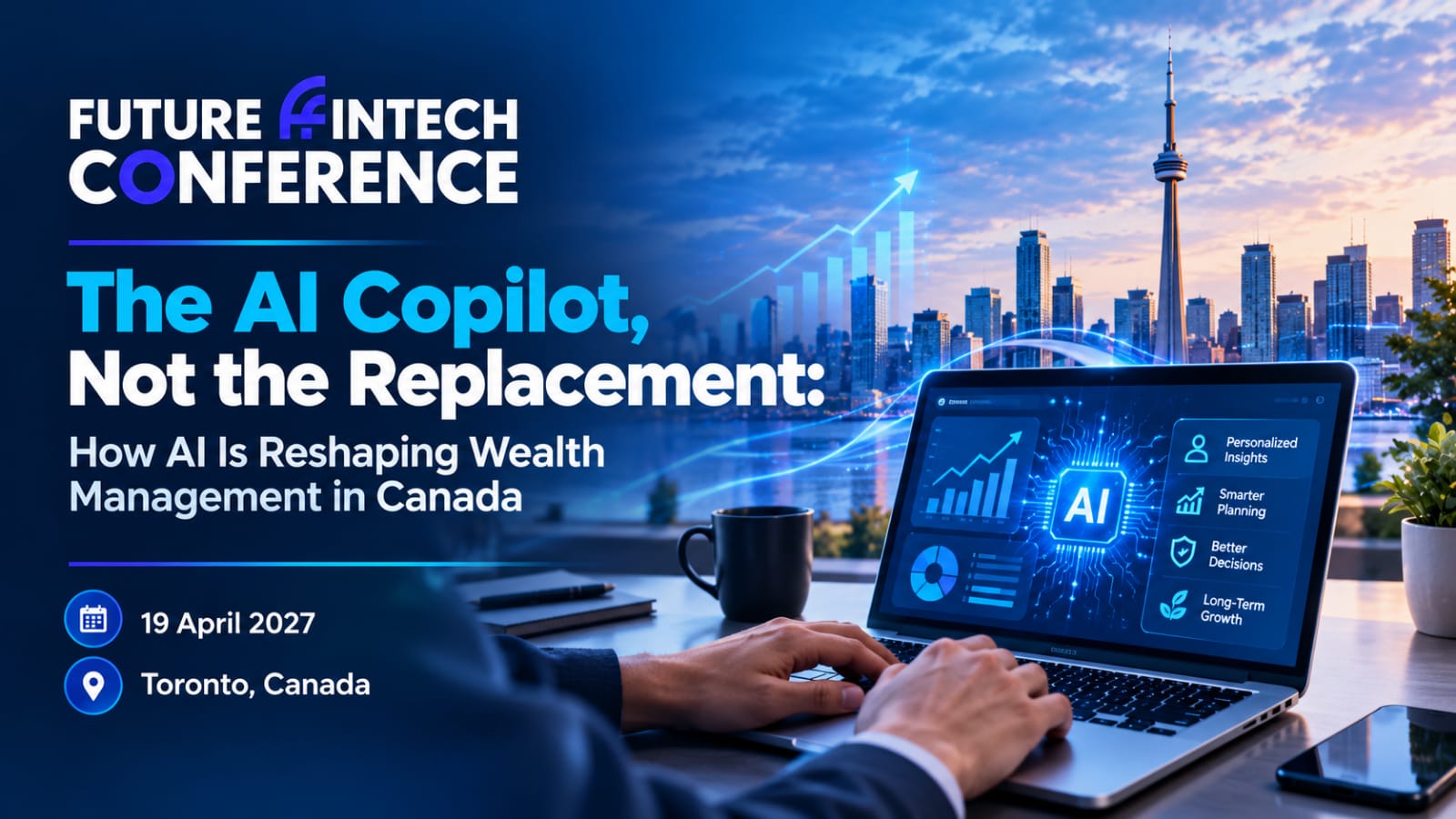
The idea that artificial intelligence will completely replace human financial advisers is giving way to a different model: AI working alongside professionals to improve productivity, personalization and client service.
Across Canada's wealth management landscape, stronger data capabilities, changing client expectations and fee pressures are accelerating AI adoption. Financial institutions are moving beyond experimentation, using AI to support research, reporting, client engagement and other advisory workflows.
Major institutions like the Royal Bank of Canada have emerged as leaders in financial-services AI adoption. RBC ranked third globally in the 2026 Evident AI Index, while its AI tools are being used to accelerate research and other knowledge-intensive tasks. RBC says its Aiden QuickTakes technology can produce draft research reports up to 95% faster.
The shift is becoming clear: AI is not necessarily replacing the adviser. Instead, advisers who can use AI effectively may gain an advantage in productivity, responsiveness and scale.
From Administrative Burden to Hyper-Scale
For years, administrative work has been one of the biggest constraints on adviser productivity. Note-taking, client documentation, research, reporting, onboarding and compliance-related tasks can consume significant amounts of an adviser's time.
Generative and agentic AI are beginning to address some of these bottlenecks. Deloitte projects that agentic AI could deliver approximately 30% to 100% productivity gains for wealth advisers by 2032 as more routine activities become automated.
Advisers can use AI to summarize market developments, research reports and regulatory information, helping them prepare more customized client materials in less time. AI can also identify relationships across business and client data, potentially helping firms identify relevant products or services and uncover opportunities that may otherwise remain hidden.
The Rise of Verifiable Advice
The growing use of general-purpose AI has also created a new challenge for advisers. Clients can now arrive at meetings with investment ideas or financial strategies generated by tools such as ChatGPT and Claude. These outputs can contain inaccurate, incomplete or outdated information, creating challenges when they are used in regulated financial advice.
This is driving interest in AI systems that combine automation with traceability and controlled financial logic.
Canadian wealth-planning platform Conquest Planning has developed a deterministic AI-based approach through its Strategic Advice Manager. The platform is designed to make recommendations traceable from inputs to outputs, giving advisers a more auditable framework for generating personalized financial strategies.
The direction is significant for wealth management: the future of financial AI is likely to depend not only on what a model can generate, but also on whether its recommendations can be explained, reviewed and governed.
Winning the Battle for Trust and ROI
The rapid expansion of AI investment does not guarantee business value. A 2026 HCLTech study found that 84% of wealth management firms believe their operating models need fundamental redesign to capture AI's value, while only 12% are measuring whether those changes are generating new revenue.
For Canadian wealth managers, the competitive question is therefore moving beyond which AI tools they use. Data governance, integration and the ability to securely use proprietary client information could become increasingly important differentiators.
Firms will need to balance personalization and automation with privacy, cybersecurity, regulatory oversight and client trust. The most effective AI strategies are likely to be those that connect technology investment to measurable improvements in productivity, client experience and business performance.
The Future: A Hybrid Financial World
The wealth management industry is moving toward a hybrid model in which digital platforms and AI-supported tools handle an increasing share of analytical and operational work, while human advisers remain central to complex decisions, relationships and trust.
PwC has projected that assets managed by algorithm-driven and increasingly AI-enabled digital platforms could approach US$6 trillion by 2027. This points to the growing scale of technology-enabled wealth management, but it does not eliminate the role of human professionals.
The next phase of Canada's WealthTech evolution will therefore be less about replacing advisers and more about augmenting them. By combining human judgment with AI's ability to process information at scale, wealth managers can potentially deliver more personalized advice while spending more time on the client relationship.
These developments will be relevant to discussions at the Future Fintech Awards & Conference Canada 2027, taking place on 19 April 2027 in Canada. The event will bring together fintech innovators, financial institutions, investors, startups and technology leaders to examine the technologies and strategies shaping the future of financial services.
Register now: https://www.futurefintechconference.com